
By Tom Emery
It was an otherworldly postscript – literally and figuratively – on a tumultuous year. The reading of Genesis by the astronauts of Apollo 8 while orbiting the moon was a moment that thrilled and inspired hundreds of millions around the world. The exhilarating event on Christmas Eve 1968 is considered one of the hallmarks of America’s race to the moon.
“Everyone was just in awe of it,” said Karen Beach, 73, who was a high school junior in Virginia at the time. “It was a time of thinking that anything was possible. We all felt like, if the astronauts can do that, we can do anything.”
Apollo 8, which launched at 7:51 a.m. Eastern time on Dec. 21, 1968, was the first human spaceflight to reach the moon, and the first in lunar orbit. Ironically, the backup crew for Apollo 8 included Neil Armstrong and Edwin “Buzz” Aldrin, who would become the first men on the moon with Apollo 11 seven months later.
The Apollo 8 mission was commanded by Frank Borman, who was in his second and last spaceflight. He was joined by James Lovell, the command module pilot and a veteran of two previous spaceflights. Lovell had replaced Michael Collins, the command module pilot on Apollo 11, who had undergone disc surgery in July 1968.
In April 1970, Lovell would command the ill-fated Apollo 13 mission, which limped back to Earth in harrowing fashion after a damaging explosion. William Anders, the lunar module pilot on Apollo 8, was in the lone spaceflight of his career. They would become the first humans outside the low Earth orbit. Throughout the space race, American astronauts had always seemed to say the right thing, finding the words to inspire the billions who watched from below. Apollo 8 would be no exception.
Prior to the flight, Borman had been advised by NASA that a Christmas Eve broadcast was being scheduled. After consulting with a couple of friends and associates, Borman was advised that a few verses from Genesis would be appropriate. Lovell and Anders agreed with Borman, and the passages were typed on fireproof paper for inclusion in the flight plan.
The message was a calming voice to end the unsettling year of 1968. The assassinations of Martin Luther King and Robert F. Kennedy had gripped the United States, while the Vietnam War dragged on with heavy casualties amid widespread protest. The bloody chaos of the Democratic National Convention that August in Chicago further shook the nation’s core, and the Soviet takeover of Czechoslovakia that summer heightened the Cold War.
As Apollo 8 raced to the moon in the days before Christmas, it seemed the nation was adrift and hopelessly divided. The craft reached the moon in sixty-eight hours and circled in lunar orbit ten times.
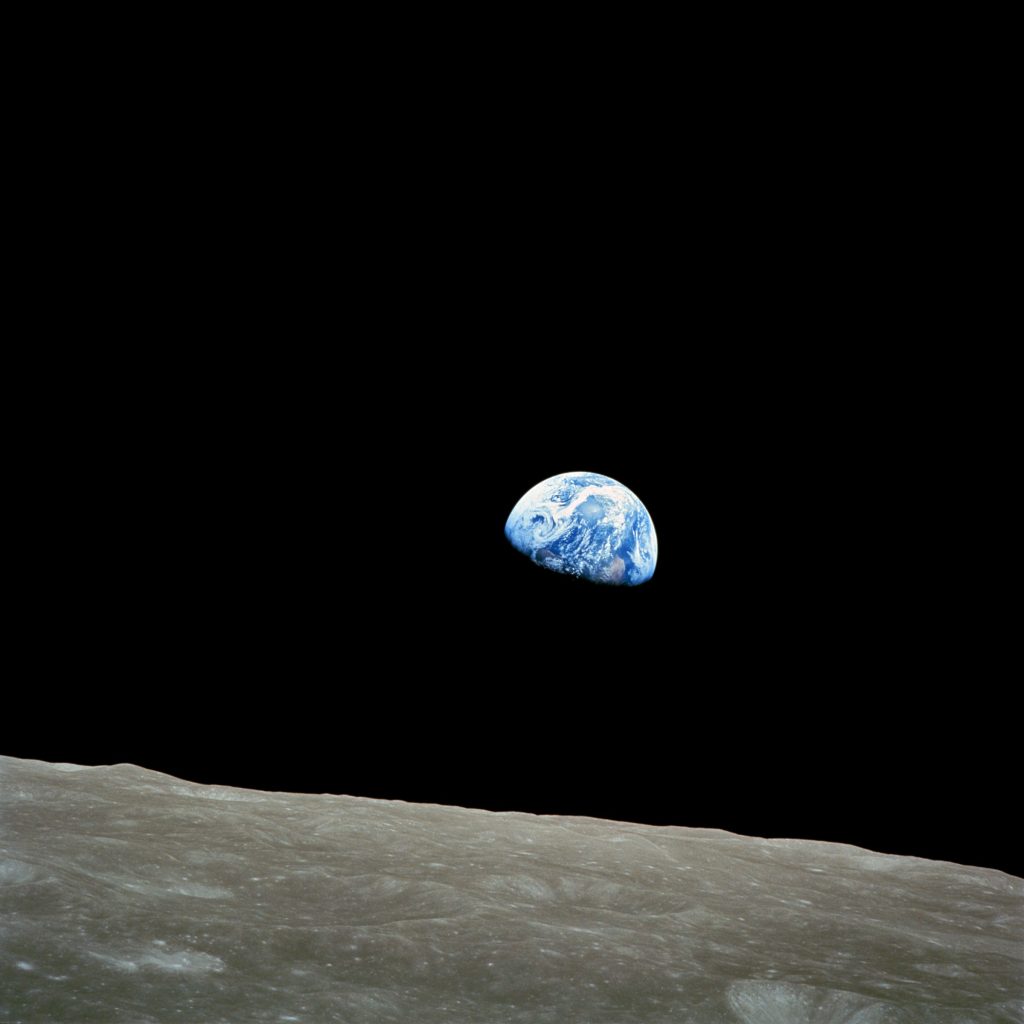
The fourth orbit brought a titillating moment of its own. As Borman tilted the nose of the spacecraft toward Earth, the crew was awestruck by the spectacle of the bright blue Earth, rising above the dark of the endless horizon above the gray lunar surface. “Look at that picture over there!” exclaimed Anders. “Here’s the Earth coming up. Wow, is that pretty!” He called to Lovell to hand him some color film, and snapped a photo later titled “Earthrise.”
The image became synonymous not only with the beauty of our planet, but also the hope and inspiration of space exploration. Life Magazine later included Earthrise in its top one hundred photos of the twentieth century. “That photo of Earth is one of the things about Apollo 8 that I remember most,” said Peter Oswald, 70, who was an Iowa teenager at the time. “That was so impressive, and it has really stayed with me. Seeing the image of the Earth in that way is something I’ll never forget.”
The ninth orbit fell on Christmas Eve. The fourth of six scheduled broadcasts from the crew began at 9:30, and each of the astronauts relayed their thoughts as the camera showed the surface of moon. Borman said the moon was “a vast, lonely, forbidding-type existence,” while Lovell noted “the vast loneliness up here of the moon is awe-inspiring, and it makes you realize just what you have back there on Earth.” Anders used the words “forbidding” and “foreboding.”
Anders then opened the seminal moment. “We are now approaching lunar sunrise,” he said, “For all the people back on Earth, the crew of Apollo 8 have a message that we would like to send to you.” He proceeded by reading verses 1–4 of Genesis, starting with “In the beginning God created the heaven and the Earth.” Lovell followed with verses 5–8, while Borman closed with verses 9–10.
Borman then added the words that have also defined the moment. “And from the crew of Apollo 8,” he said, “we close with good night, good luck, a Merry Christmas, and God bless all of you – all of you on the good Earth.”
Five and a half decades later, Oswald is still moved by the words from Apollo 8. “At the time, it all made sense,” said Oswald, an active member of his local church. “To me, the reference to the creation story showed us the awe and vastness of it all. The astronauts were experiencing something that no one had ever done before, and their words were humble and reverent.”
“It was a monumental event,” remarked Oswald. “Every one of the space flights brought something new, and people paid such attention to each of them. But Apollo 8 was just remarkable.”
Dan Brannan, 64, remembers watching the transmission on a black-and-white television set with his father in Carrollton, IL. “My dad would always stay up and watch the news, particularly events with NASA,” said Brannan. “I was fascinated with space myself as a boy.
“I was just eight years old at the time (of Apollo 8),” remarked Brannan, “but even though I was so young, I knew how impactful that message would be.”
Teasel Muir-Harmony, the curator of the Smithsonian and an acclaimed space historian, estimates that one in four people on the globe heard the reading. The words were broadcast live in 64 countries, while another 30 nations heard a recorded version by the next day. Even in Cuba, then a nation hostile to the U.S., Radio Havana called the mission “a total success.” Borman, who died in November 2023, received over 100,000 letters of support for the broadcast. Anders perished from a crash while flying his private plane in June 2024. Lovell, the last remaining member of the crew, died at age 97 in August 2025.
Apollo 8 returned to Earth with a splashdown in the Pacific at 10:51 a.m. EST on December 27. Time Magazine honored the Apollo 8 crew as its Men of the Year in 1968. Collins later said that “Eight’s momentous historic significance was foremost.” Fifty-seven years later, the astronauts’ words of Genesis, broadcast from a part of the universe previously unseen, still linger as a symbol of humility and peace.
Tom Emery is a freelance writer and historical researcher from Carlinville. He may be reached at ilcivilwar@yahoo.com or 217-710-8392.








Leave A Comment